If a breaker trips immediately on reset with nothing plugged in, leave it off. That pattern means current is reaching a fault directly — repeated resets push current through that fault. Call (916) 903-0277.

Tripping Breaker

Breaker keeps
tripping

A breaker that trips once and holds after a reset is usually fine — it did its job. A breaker that trips again, or trips immediately when reset, is carrying a different message. The timing of when it trips tells you which type of problem you’re dealing with, and the three types have different causes and different repairs.

Diagnostic visits are a paid service. See pricing →
5-Star Rated on Google & Yelp
Veteran Owned & Operated
CA LIC #1154062 C-10
Same-Day Service Available
24/7 Emergency Response
Read the Pattern First

When it trips tells you
what type of problem it is

Before anything else, note exactly when the breaker trips. This is the single most useful piece of information for diagnosing the cause.

Trips immediately on reset — with nothing running

If the breaker trips the instant you push it to ON, before any load is connected, you have a hard fault on the circuit: either a short circuit (two wires contacting each other) or a ground fault (a live wire contacting a grounded surface). The fault may be at an outlet, a fixture, a junction box, or in the wiring itself. Leave the breaker off and do not keep resetting it. Call us.

Trips after running — under normal load

If the breaker holds for a while then trips after running appliances, the circuit is likely pulling more current than it’s rated for. This can happen because too many loads are on the circuit, because a specific appliance has a failing motor drawing excessive current, or because a connection is loose and generating resistance heat that eventually trips the breaker. The circuit may also be undersized for what’s now plugged into it.

Trips occasionally with no obvious pattern

Intermittent tripping — where the breaker trips sometimes but not consistently — often points to a marginal condition: a connection that loosens under thermal expansion, a load that spikes on startup rather than running continuously, or a breaker whose trip threshold has weakened from age. Intermittent faults are the hardest to catch on a single diagnostic visit, but they leave evidence. A connection loose enough to cause intermittent trips can also cause flickering on the same circuit — if you’re seeing both, see Flickering Lights.

Important

Why repeated resets
make it worse

Each reset drives current through the fault

A breaker trips to interrupt current. When you reset it with a fault still present, you restore current flow to the fault location. On a short circuit, that means arcing. On an overloaded connection, that means more heat at a point already degraded by heat. Each reset that ends in a trip degrades the wiring, the connections, or the breaker itself a little more.

Breakers are not designed for unlimited resets

A breaker’s trip mechanism has a mechanical lifespan. Repeated tripping — particularly on hard faults — accelerates wear. A breaker that has tripped and been reset many times on a fault may need replacement even after the underlying issue is corrected, because its trip threshold may have shifted.

The correct response to a repeatedly tripping breaker

Unplug or turn off everything on the affected circuit. Reset the breaker once. If it holds with nothing on the circuit, the problem is load-related and you can add loads back one at a time to identify which one is causing it. If you find a specific outlet on that circuit is dead even after the breaker resets, see Outlet Not Working. If it trips immediately with nothing on the circuit, leave it off and call for a diagnostic.

The Diagnostic

What we measure
and inspect

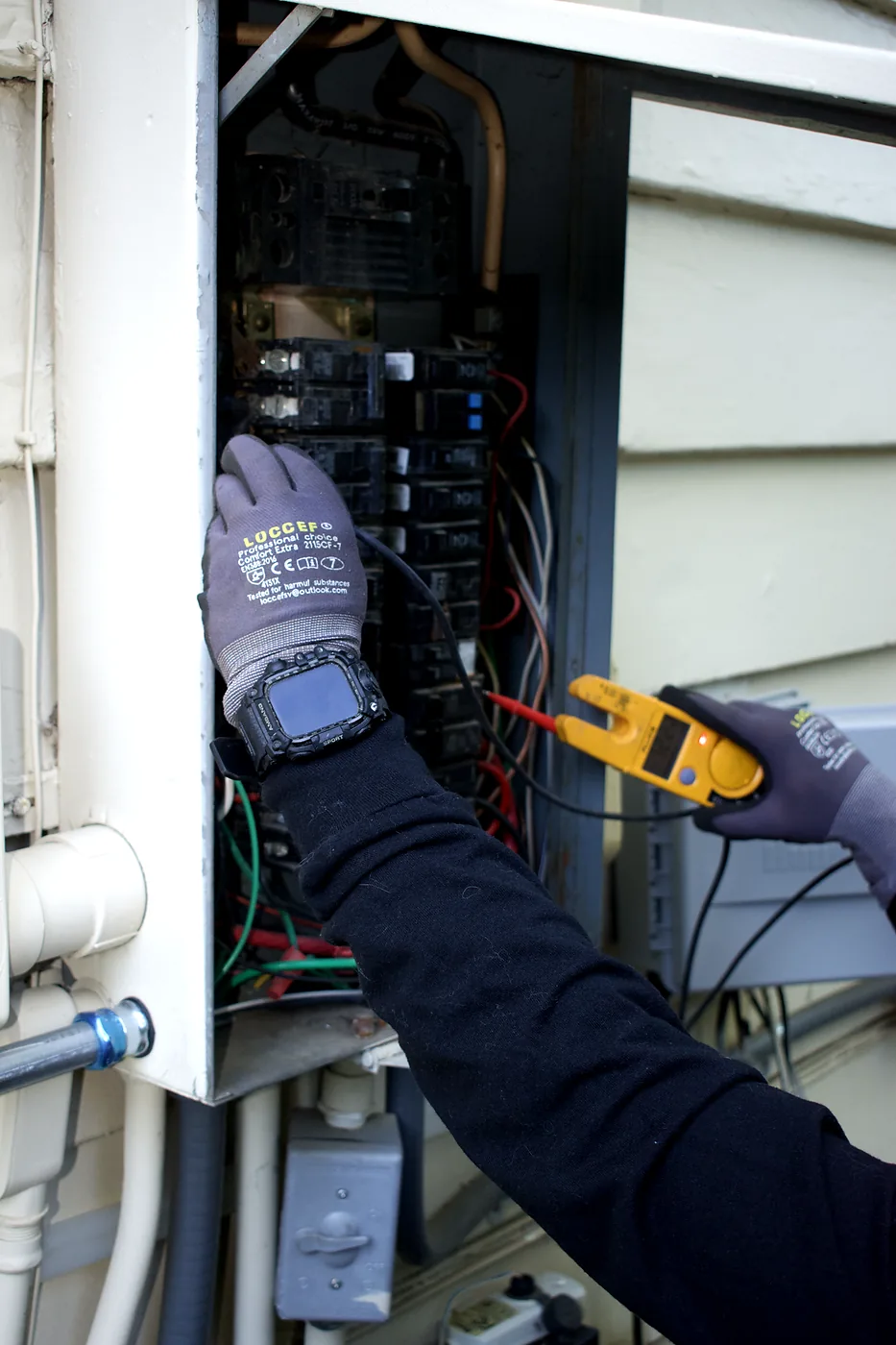
Diagnosing a tripping breaker means distinguishing between three different root causes. Each one requires different measurements.

Current draw on the circuit

We clamp-meter the circuit under load to measure actual current draw against the breaker’s rating. An overloaded circuit is the simplest cause and the most straightforward to confirm — the numbers either exceed the rating or they don’t. If the circuit is running well within its rating when the breaker trips, overload is ruled out.

Short circuit and ground fault testing

With the breaker off, we test the circuit for continuity between conductors that shouldn’t be touching. A short between hot and neutral or hot and ground shows up clearly on resistance testing. We then trace where on the circuit that fault is located — it could be at an outlet, a fixture, inside a wall box, or at a damaged section of wire.

Breaker condition and panel inspection

We inspect the breaker itself for signs of heat damage, arcing, or physical wear, and check the breaker’s response against what the circuit actually draws. We also look at the panel for signs of overheating at the bus or at the breaker terminals — a failing connection at the breaker’s landing point can cause the same symptoms as an overloaded circuit.

If the circuit needs more capacity than it has: that’s a panel and circuit question, not just a repair. See Panel Upgrades if the underlying issue is an undersized panel or a panel with no room for additional circuits.

Common Questions

Tripping breaker
FAQ

Is it safe to keep resetting a tripping breaker?

Not if it keeps tripping. A breaker that trips once under an unusual load and holds after a reset is generally fine — it did its job. A breaker that trips again and again, especially one that trips immediately when reset with nothing running, is responding to a real fault condition. Resetting it repeatedly forces current through that fault and can cause arc damage inside the panel or to the wiring. Leave the breaker off, unplug what was on that circuit, and have it diagnosed.

Can a breaker just wear out and start tripping?

Yes. Breakers are mechanical devices with a trip mechanism that can weaken over time, particularly in panels that are decades old. A breaker that trips at loads it previously handled without issue — and where there’s no evidence of overload or wiring fault — may have a weakened trip threshold. This is more common in older panels, in breakers that have tripped many times over the years, and in certain brands known to have reliability issues.

What's the difference between a tripped breaker and a bad breaker?

A tripped breaker responded to a real condition on the circuit — overload, short circuit, or ground fault — and is working correctly. A bad breaker fails at one of two things: it trips at loads it should handle (weakened mechanism), or it fails to trip under conditions that should trigger it, which is the more dangerous failure. Distinguishing between a normal trip response and a failing breaker requires measuring the actual load on the circuit and comparing it to the breaker’s response.

My breaker tripped during a storm — is that different?

It can be. A utility voltage surge during a storm can trip a breaker that wouldn’t trip under normal load. If the breaker resets and holds after the storm with normal loads, it may have simply done its job. If the breaker trips again under normal conditions after the storm, or if any connected equipment behaves abnormally, have the circuit checked. Surge damage to wiring or devices doesn’t always show up immediately.

Leave the breaker off.
Let’s find the cause.

We come out, measure the circuit, inspect the panel and wiring, and tell you what’s causing it before any repair starts. Sacramento and the greater Sacramento area.

Diagnostic visits are a paid service. See diagnostic pricing →